Roll-to-Roll Printing + Film Lamination

Film Lamination & Roll-to-Roll Calender

The ML Series is a dual-purpose industrial calender that performs both roll-to-roll sublimation printing and film lamination. It shares the same core architecture as the MR roll-to-roll machine, adapted for lamination through a front-mounted film feed unit and a rear external rewind module. One shift can run sublimation printing on fabric rolls, and the next shift can run TPU / PU / PE film lamination on the same machine. Two separate capital investments are no longer required. Outdoor apparel, rainwear, softshell jackets, automotive interior trim, medical protective garments, tents and backpack fabrics — plus home textile and advertising fabric printing when needed — a single machine covers the full range.

Unwind Station

Motorised unwind unit with tension feedback. Delivers stable feed.

Ready to configure your line?

Send your production width, substrate and target throughput — we reply within one business day with a tailored quote, drawings and delivery timeline.

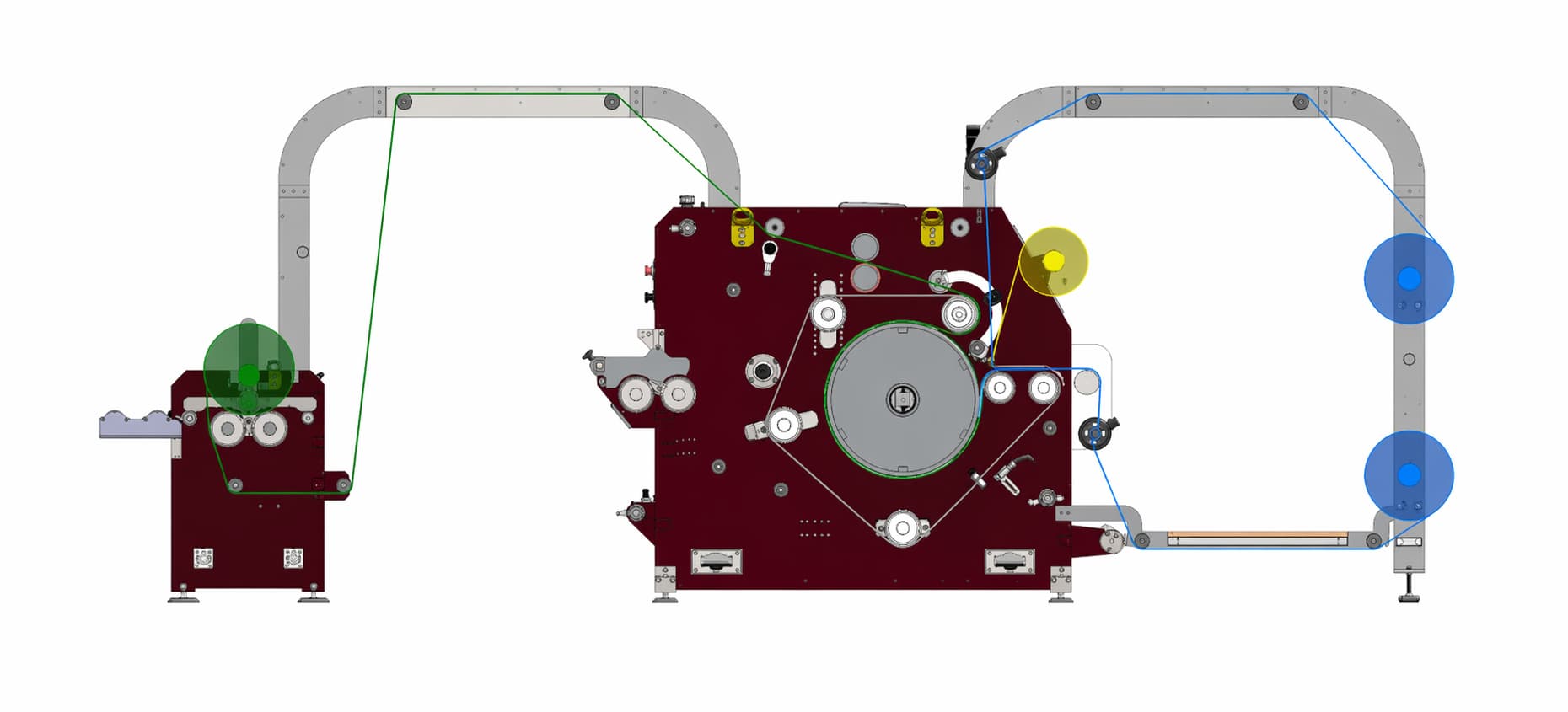
FLOW DIAGRAM
PROTECTION PAPERFABRICFinished Fabric
Roll flow: protection paper, digital transfer paper and fabric

Applications and Industries

The ML Series runs both film lamination and roll-to-roll sublimation printing. Applications split into two categories: Film lamination (primary use): • Outdoor apparel: rainwear, softshell jackets, hardshell parkas, trekking pants • Technical textile: tent fabric, backpack fabric, waterproof tarps, agricultural covers • Automotive interior: seat covers, door-panel fabric, headliners • Medical textile: disposable protective wear, surgical drapes, medical bed covers • Home textile: waterproof curtains, bathroom curtains, decorative laminated fabric • Sports gear: swimwear lamination, climbing-jacket fabric, ski suits • Fashion: metallic PU / TPU laminated fabric, leather-look PU, glittery decorative panels Roll-to-roll sublimation printing (secondary use): • Home textile: curtain fabric, quilt panels, bed protectors • Advertising: trade-show stand fabric, banners, building-facade covers • Promotional: corporate flags, stoles, large-campaign fabric Lamination and sublimation shifts can run separately on the same machine.

Capacity and Configuration Range

The ML Series is a dedicated film lamination and sublimation transfer chassis — both duties run on one roll-to-roll frame, not a retrofitted calender. Film laminasyon station (unwind, nip, heated drum contact, optional cooling) shares the core drive, PLC touchscreen and oil heating with our sublimation platform, so operators already trained on MB transfer duty step onto the ML without relearning the controls. Drum diameters are Ø400, Ø600 and Ø1000 mm. The Ø400 mm drum suits lighter home-textile films on mid-width production, Ø600 mm is the lamination workhorse for curtain backing, coated carpet edges and technical fabric, and Ø1000 mm covers long-dwell work on heavier outdoor and blackout composites. Working widths run from 1700 mm up to 4400 mm. Three sizes are fully documented reference points. ML-170W-400D draws 23 kW total (21.5 kW resistance, 34.9 A), heats to 230 °C, runs pneumatic felt tension with a pull-rope emergency stop and plates out at 2900 × 4700 × 1910 mm. ML-190W-400D steps up to 28 kW with pneumatic-piston felt tension for steadier lamination under film load. ML-440W-600D is engineered around a dual resistance bank — 2 × 43 = 86 kW, 89 kW total, 135 A — so the heated drum recovers temperature evenly across the full 4400 mm width. Remaining widths across the Ø400, Ø600 and Ø1000 mm groups — 2200, 2600, 3300, 4400 mm and the full 1000 mm drum range — are engineered per project specification. Film type, feed speed and factory layout drive the final power draw and mechanical layout. All ML builds include a dedicated unwind station and oil heating to 230 °C, with AC-inverter speed control and optional cooling rollers on the outfeed — specify on quote.

Integrated Safety Systems

The industrial design of the ML Series includes 14 independent layers of protection. Operator safety • 4 emergency stop buttons + pull-rope emergency stop — strategically placed around the large machine • Audible alarm and visual indicator (yellow lamp) Electrical protection • Phase protection — cuts on voltage fluctuation • Fuse protection — isolates on circuit fault • Earth-leakage protection — cuts on residual current • Contactor protection system Thermal protection • Automatic overheat cut-off at 240 °C • Heating-circuit protection Drum safety • Drum pressure-relief system — automatic release on abnormal pressure inside the drum Pneumatic system safety • Air-loss protection — when the compressor fails or air supply stops, the machine auto-detects the lack of pneumatic pressure, drops speed to minimum, and runs the felt forward and backward in short intervals to prevent it from drifting sideways. The felt stays safe until air returns. PLC and sensor reliability • PLC safety monitoring — tracks electrical and mechanical faults centrally • Sensor-fault detection — backup circuit engages if main sensor fails • Sensor-cable protection — safe lockout on mechanical disconnection For warranty, installation and service details, contact our team.

Design Decisions Behind the ML Series

Two jobs, one machine. The ML shares the same core roll-to-roll sublimation calender architecture as the MR. A front-mounted film feed unit and a rear external rewind module adapt the same machine to lamination. Two separate capital investments are no longer required; as your production mix shifts, the machine can switch between the two jobs. Three film-type support. TPU (waterproof + breathable, for outdoor and performance apparel), PU (soft and flexible, for underwear and medical products) and PE (low-cost, for disposable products) — each with different temperature and pressure ranges; the machine runs in a configuration suitable for all three. Gradual cooling exit. Controlled cooling after lamination decides quality — sudden cooling disrupts film tension and causes wrinkling. At the ML exit, cooling rollers provide a stepped temperature drop. PLC touchscreen control + recipe memory. Parameter profiles for different film types, fabric combinations and sublimation jobs are stored. When the job type changes, the operator loads the right recipe with one touch. Weekly scheduling + automatic cooldown — time saved. If work starts at 08:00, set the machine to warm up at 07:00 — it is ready by 08:00. At end of shift, one touch puts the machine into automatic cooldown; it shuts down safely once under 90 °C. Automatic resume after power loss. Short interruptions preserve PLC settings; when power returns, the machine picks up where it left off — no separate UPS required. For long outages, a UPS input port is standard for those who want to connect an external UPS. 220V voltage option. In addition to the standard configuration, the machine can be delivered in a 220V build for countries with 220V infrastructure. Specified at order. Natural extension for a sublimation customer. When a sublimation customer expands into technical textiles and needs film lamination, they can stay with the same manufacturer. Operator training, service relationship and spare-parts process are shared. Internationally readable model code. The ML format directly states working width and drum diameter — a foreign buyer grasps it instantly in the technical catalogue.
Call
WhatsApp
Get Quote